How to Rescue a Messy AI Built Codebase Before It Touches Patient Data
A messy AI built codebase is a liability the moment it touches real patient data. Here is how to clean it up and secure it before that happens.
Published:
October 15, 2026
This is some text inside of a div block.
How to Rescue a Messy AI Built Codebase Before It Touches Patient Data
A codebase built quickly with heavy AI assistance often reaches a point where adding one more feature feels harder than it should, where nobody is quite sure why certain things were built the way they were, and where the idea of connecting it to real patient data starts to feel genuinely risky rather than just a formality to get through. That instinct is usually correct, and the good news is that a messy AI built codebase is almost always rescuable without starting over.
The First Step Is Admitting What Actually Needs to Happen
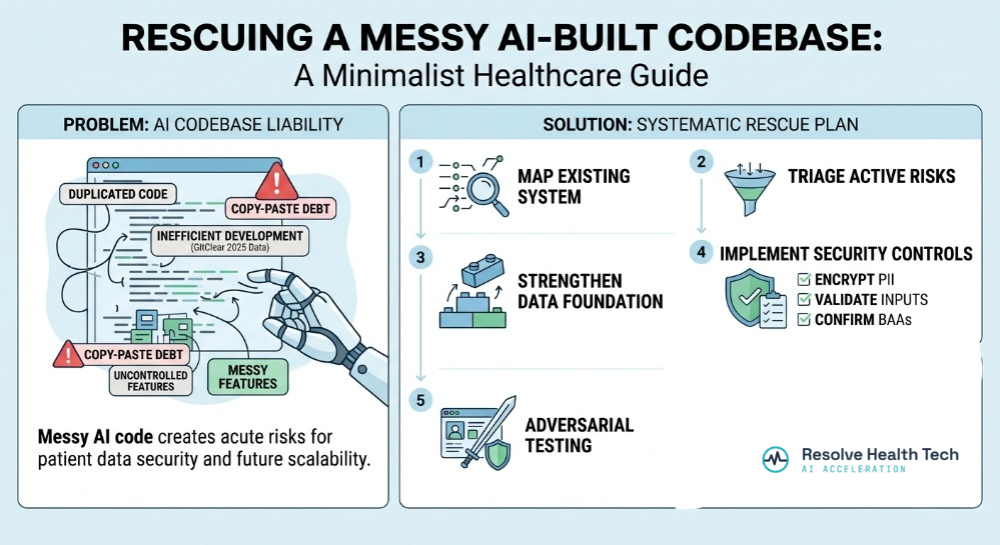
Rescuing a messy codebase starts with treating it as exactly that, a first draft that needs real engineering attention, rather than a finished product that just needs a few tweaks before launch. GitClear's 2025 analysis of over 200 million lines of code found that duplicated code blocks increased eightfold in 2024 as AI coding assistants became standard, while the share of code getting properly refactored dropped to under 10 percent, the lowest level the study had recorded. That is not a codebase quietly getting cleaner over time. It is one accumulating exactly the kind of copy paste debt that feels fine at a glance and becomes expensive the moment someone actually needs to trust it.
Step One: Map What Is Actually There
Before fixing anything, someone needs an honest picture of what the codebase actually contains, not what the original build plan intended. That means tracing how patient data enters the system, where it is stored, which functions and API calls touch it, and where it ends up. This step alone often surfaces the first uncomfortable discoveries, inconsistent data structures, forgotten debug logging, an AI vendor integration nobody remembers configuring carefully.
Step Two: Triage by Actual Risk, Not by What Feels Urgent
Not every issue found in step one needs the same priority. Active exposure, an unencrypted PII field, a missing BAA for a vendor already receiving real data, a cross patient contamination bug, needs to move to the front of the line immediately. Code quality issues that make future development slower but do not expose data yet can wait a little longer. Sorting findings this way keeps a rescue effort from turning into an unfocused rewrite of everything at once, which rarely finishes on any reasonable timeline.
Step Three: Fix the Data Structure Before Building More on Top of It
AI tools optimize for a working feature, not a coherent data model, which means patient records, session notes, and related data often end up loosely connected in ways that get harder to untangle the longer they sit. Fixing this structure before adding new features is almost always cheaper than continuing to build on an inconsistent foundation and untangling it later, once several more features depend on the same broken structure.
Step Four: Add the Security Controls That Were Never There
This includes encrypting PII consistently rather than in some places and not others, adding input validation where AI generated code tends to skip it, removing debug logging that captures more than it should, and confirming every AI vendor relationship has a BAA that actually covers the specific service in use. None of these fixes require rebuilding the application. They require going through it systematically with a checklist built around exactly the patterns AI generated code is known to miss.
Step Five: Test It the Way an Attacker Would, Not the Way a Demo Would
A rescued codebase needs to be tested adversarially before it is trusted with real patient data, checking whether one patient's information can appear in outputs about another, whether unusual input can manipulate the system into behaving unexpectedly, and whether the application holds up under real concurrency rather than a handful of test accounts. This is the step most rescue efforts skip, since it takes real effort and does not produce a visible new feature, which makes it easy to deprioritize right up until it matters most.
What a Real Rescue Looks Like Start to Finish
A behavioral health platform's client intake app was built almost entirely with AI assistance over a few fast weeks, and eight months later the team decides it is time to review it properly before adding a planned AI summarization feature on top. Mapping the codebase turns up patient identifiers stored inconsistently across three tables, debug logging still capturing full form submissions in production, and a messaging vendor with no confirmed BAA for the specific endpoint in use. Triage puts the vendor agreement and the logging exposure first, since both represent active risk right now. The data structure cleanup follows over the next two weeks, timed so the new summarization feature can be built on a coherent foundation rather than the tangled one underneath it. Adversarial testing at the end confirms no cross patient contamination exists in the retrieval logic feeding the new feature. None of this required rewriting the application from scratch. It required going through it systematically, in the right order.
How Do You Know When the Rescue Is Actually Done?
A rescued codebase is ready when every place PII enters the system has been traced and secured, every AI vendor relationship has a verified agreement matching actual usage, the data structure is coherent enough to support future features without repeating the same problems, and the application has been tested adversarially rather than just functionally. Our AI Acceleration Sprint runs exactly this sequence, mapping, triaging, and fixing a messy codebase within a fixed six week engagement.
Is Rescuing Cheaper Than Starting Over?
Almost always. A full rewrite throws away everything that already works correctly, which in most codebases is still the majority of it, in exchange for redoing work that was never actually the problem. Rescuing targets specifically what is broken, which tends to take a fraction of the time and cost of starting from a blank slate. Our pricing page lays out what a structured rescue costs compared to both a full rewrite and the cost of leaving the codebase unaddressed.
Frequently Asked Questions
How do we know if our codebase needs a rescue or just a normal code review? If the codebase was built primarily with AI assistance and has never had a security focused review specifically looking for the vulnerability patterns AI tools introduce, treat it as needing a rescue rather than a routine review.
Can this happen while the product keeps shipping new features? Active exposures should be addressed immediately, but most of the rescue work can run alongside continued feature development if it is sequenced deliberately rather than treated as an all or nothing pause.
What if real patient data is already flowing through the messy codebase? That raises the urgency but does not change the approach. Triage active exposures first, since they represent real risk right now, then work through the rest of the sequence. Our FAQ page covers a few more scenarios like this one.
How long does a full rescue typically take? A focused rescue effort surfaces the most critical issues within the first two weeks and typically completes within four to six weeks, depending on how much of the codebase needs attention.
Do we need to pause new feature development during a rescue? Not entirely. Active exposures usually need immediate attention, but planned feature work can often continue in parallel once the sequencing accounts for which parts of the codebase that new feature will actually depend on.
Getting a Messy Codebase Ready for Real Patient Data
Resolve Health Tech rescues AI built healthcare codebases before they touch real patient data, or catches up on the work for ones that already have. Contact us to find out what your own codebase actually needs.
Author: Sana Fatima
Sana is a Technical Content Specialist at Resolve Health Tech. She specializes in breaking down complex architectural patterns, nearshore hiring trends, and software engineering workflows into actionable, human-friendly guides. Working alongside Resolve Health Tech's tech team, Sana ensures every piece of content is both highly readable and technically precise.