Does Your AI Vendor's BAA Cover the New HIPAA Security Requirements?
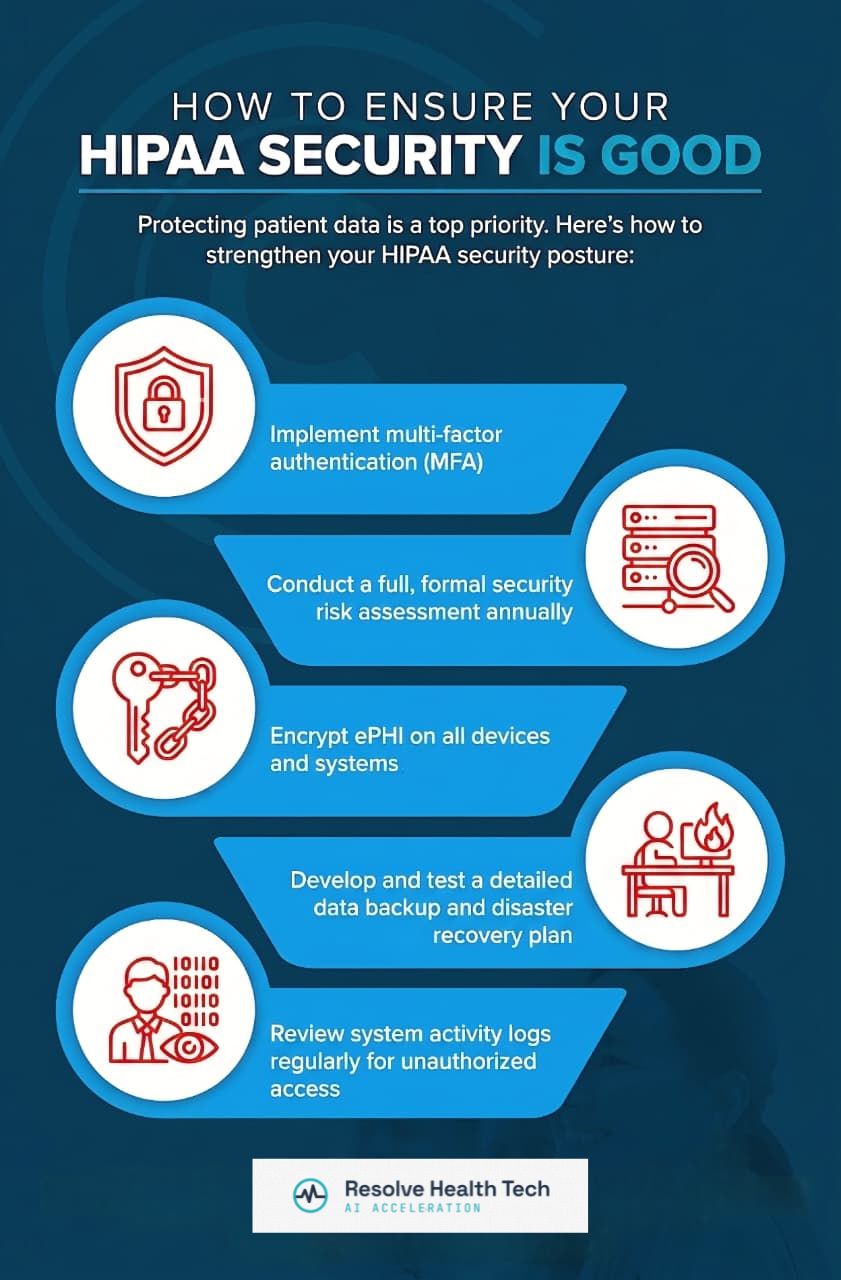
The proposed 2026 HIPAA Security Rule would require BAAs to explicitly cover encryption and MFA. Here is what to check in your AI vendor agreements now.
Published:
September 29, 2026
This is some text inside of a div block.
Does Your AI Vendor's BAA Cover the New HIPAA Security Requirements?
A signed Business Associate Agreement with an AI vendor feels like a settled question once it exists. The proposed HIPAA Security Rule update working through the federal process right now would make clear that a signature alone was never really the finish line, and that a BAA needs to actually reflect specific technical safeguards, not just acknowledge that PHI will be handled responsibly in general terms.
What the Proposal Would Change About Business Associate Agreements
Beyond the widely discussed encryption and multi factor authentication mandates, the proposed rule would tighten expectations around what a business associate agreement actually needs to document. Covered entities would be expected to obtain written verification, not just a signed agreement, that a business associate has implemented the required technical safeguards. OCR's enforcement priorities have already been shifting toward exactly this kind of documented verification under the current rule's risk analysis requirements, even before any new rule formally requires it, treating a vague or outdated BAA as evidence of an incomplete risk management program.
Why This Matters More for AI Vendors Specifically
AI vendor relationships tend to move faster than the paperwork behind them. A team signs a BAA when a relationship starts, then the vendor adds new services, changes retention defaults, or updates its infrastructure, all without the underlying agreement being revisited. A BAA signed a year ago, before the vendor added a new model tier or a new data processing feature, may not reflect what the vendor's systems actually do today. The proposed rule's emphasis on written verification of specific technical safeguards would make that kind of drift a documented compliance gap rather than an informal oversight.
The Questions a Real BAA Review Needs to Answer
A proper review of an AI vendor's BAA needs to go past confirming a signature exists. Does the agreement specify encryption requirements for data at rest and in transit, or does it use vague language about "appropriate safeguards" that could mean almost anything? Does it address multi factor authentication for any administrative or engineering access to systems processing PHI, not just end user access? Does it name the specific service, tier, and configuration actually in use, or was it written broadly enough that it could apply to a different product entirely? And does the agreement include a mechanism for the covered entity to actually verify these safeguards, rather than simply trusting the vendor's representation? Each of these questions tends to surface a gap in a different way. Vague encryption language is the most common finding, since it is easy for a vendor's standard BAA template to reference encryption generally without specifying whether it covers every relevant data flow, including backups, logs, and any downstream processing. Authentication language is frequently missing entirely, since most standard BAA templates were written before service to service connections between an application and an AI vendor became as common as they are now. And scope language, confirming the agreement covers the exact service in use, is where drift shows up most often, since vendors add new tiers and features faster than most organizations revisit their paperwork.
What Happens If a BAA Falls Short of This Standard?
An outdated or vague BAA does not automatically mean a breach has occurred, but it does mean an organization cannot demonstrate the kind of documented, verified security posture regulators are already expecting under current enforcement, let alone what a finalized rule would require explicitly. If an AI vendor experiences its own incident, an organization holding only a generic, unverified BAA is in a considerably weaker position to demonstrate it exercised appropriate oversight, which affects how that incident gets treated during any resulting investigation. This distinction, between having an agreement and being able to demonstrate what that agreement actually guarantees, is exactly where OCR's recent enforcement pattern has been focusing, treating the absence of verification as its own finding independent of whether any data was actually exposed.
What a Practical Review Looks Like
Reviewing AI vendor BAAs against this standard means pulling every agreement currently in place, checking each one against the specific service and configuration actually deployed today rather than what was true when the agreement was signed, and flagging any agreement using vague or outdated language around technical safeguards. For vendors where the agreement has not kept pace with how the relationship has evolved, that gap needs a plan to close it, either through an updated agreement or documented verification of the safeguards already in place. This is part of the vendor verification work our AI Acceleration Sprint runs as a standard part of every engagement.
What This Looks Like With a Real Vendor Relationship
A behavioral health platform signed a BAA with its AI summarization vendor eighteen months ago, when the relationship covered a single API endpoint. Since then, the vendor has added a newer, faster model tier that the platform's engineers migrated to for cost reasons, without anyone circling back to confirm the original BAA's language still applied. The agreement, written broadly enough to reference "AI processing services," technically still covers the relationship on paper, but nobody at the platform can point to specific language confirming the new tier's retention settings or authentication requirements match what the original agreement assumed. That gap would not necessarily show up in daily operations. It would show up the moment a customer's security team, or a regulator, asked for documented proof rather than a general assurance.
How Much Does This Kind of Review Cost?
Reviewing and updating vendor agreements costs considerably less than discovering the gap during an incident investigation or a customer's due diligence process. Our pricing page covers what a full vendor verification review includes, and our FAQ page answers a few more questions specific to BAA scope and technical safeguard language.
Frequently Asked Questions
Do we need to renegotiate every AI vendor BAA right now, before any rule is final? Not necessarily renegotiate, but every agreement is worth reviewing against what it actually covers today versus what it covered when signed, since vendor services frequently change without agreements being updated.
What language should we be looking for in a strong BAA? Specific references to encryption standards, authentication requirements, and the exact service and tier covered, rather than general language promising "reasonable" or "appropriate" safeguards without defining what those mean technically.
Does a vague BAA mean we are currently out of compliance? Not automatically, but it does mean an organization would struggle to demonstrate a documented, verified security posture if asked, which is already a factor in how OCR evaluates culpability during an investigation.
How often should AI vendor BAAs be reviewed going forward? At minimum whenever a vendor's service changes meaningfully, and as a general practice, on a regular schedule, since AI vendors update their offerings more frequently than most other categories of business associate.
Who inside our organization should own this review? It works best as a shared responsibility between whoever manages vendor relationships and whoever has technical visibility into what each vendor's service actually does, since neither a purely legal review nor a purely technical one tends to catch every gap on its own.
Making Sure the Paperwork Matches Reality
Resolve Health Tech verifies every AI vendor agreement against what the vendor's systems actually do today, not just what a signature once promised. Contact us to check where your own vendor agreements actually stand.
Author: Sana Fatima
Sana is a Technical Content Specialist at Resolve Health Tech. She specializes in breaking down complex architectural patterns, nearshore hiring trends, and software engineering workflows into actionable, human-friendly guides. Working alongside Resolve Health Tech's tech team, Sana ensures every piece of content is both highly readable and technically precise.